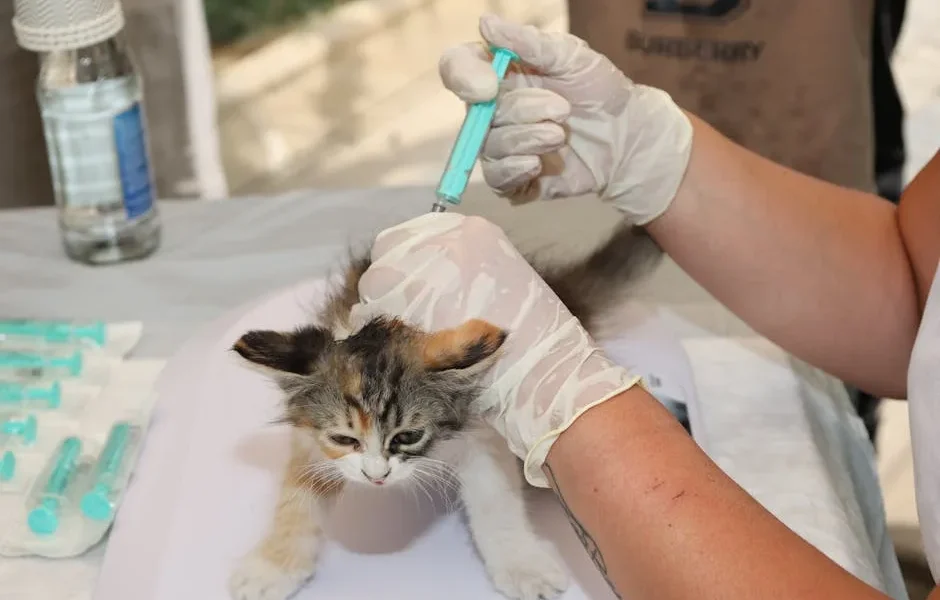
- Your cat’s vaccination schedule should be based on lifestyle, age, location, and health—not a plan that treats all cats the same.
- Core vaccines (rabies, FVRCP) are essential for all cats. But adult cats may only need boosters every 3 years. Non-core vaccines like FeLV depend on your cat’s specific risks.
- Find a vet who follows updated AAFP guidelines. They should work with you to make decisions about your cat’s care. This helps avoid over-vaccination while keeping your cat protected.
Here’s something I learned the hard way: I spent years bringing my indoor cat, Winston, in for annual vaccinations. Why? Because that’s what the reminder postcards told me to do. I never questioned it.
Then a colleague mentioned her vet used a three-year protocol for adult cats. I realized I’d been operating on autopilot.
That conversation sparked my deep dive into cat vaccinations. I learned that your cat’s vaccination schedule isn’t one-size-fits-all. Finding the right vet to customize care makes all the difference. It’s the gap between evidence-based medicine and outdated routines that might not serve your cat’s best interests.
The truth? Feline vaccination has evolved dramatically over the past decade. But not every veterinary practice has kept pace.
That gap between current research and common practice can mean problems. Unnecessary injections. Wasted money. And in rare cases, preventable adverse reactions for your cat.
The Problem With Cookie-Cutter Vaccination Schedules
Walk into most veterinary clinics. You’ll see colorful posters recommending annual vaccinations for all cats. Seems straightforward enough.
But the American Association of Feline Practitioners (AAFP) updated their guidelines years ago. They now reflect a more nuanced approach. One that considers your individual cat’s circumstances. Not one that treats every feline exactly the same.
The issue? Roughly 45-60% of cat owners still believe annual vaccinations are necessary for all cats. This is according to veterinary care usage surveys.
This perception gap exists for several reasons. Many practices haven’t updated their protocols. Vaccine reminders are often automated. And “it’s what we’ve always done” is a powerful force in any profession.
But here’s what the research actually shows: Core vaccines like FVRCP (feline viral rhinotracheitis, calicivirus, and panleukopenia) provide immunity lasting three or more years in most adult cats.
That’s not opinion. That’s documented through duration of immunity studies. These studies are published in the Journal of Feline Medicine and Surgery.
Meanwhile, non-core vaccines like FeLV (feline leukemia) aren’t appropriate for every cat. This is particularly true for cats who never go outside or interact with unknown felines.
Understanding Core vs. Non-Core Vaccines
Let’s break down what your cat actually needs. And what might be optional based on their lifestyle.
Core Vaccines (Recommended for All Cats)
These vaccines protect against diseases that are widespread, highly contagious, or pose serious health risks:
- Rabies: Legally mandated in most states. Frequency requirements vary. Some states accept three-year vaccines. Others still require annual boosters.
- FVRCP: Protects against three serious viral diseases. Kittens need a series of shots every 3-4 weeks until 16-20 weeks old. Then boosters at one year. Then typically every three years for adult cats.
Non-Core Vaccines (Depends on Risk Factors)
These vaccines should be considered based on your cat’s specific situation:
- FeLV (Feline Leukemia): Recommended for cats who go outdoors. Or cats who live with FeLV-positive cats. Prevalence in indoor-only cats is less than 3%. It jumps to 10-30% in high-risk populations.
- FIV (Feline Immunodeficiency Virus): Rarely recommended. The vaccine can interfere with testing. It’s generally less effective than keeping cats indoors.
- Bordetella and Chlamydia: Typically only for cats in high-density environments. Places like shelters or catteries.
If your cat lives exclusively indoors, their risk profile is completely different. About 60-70% of U.S. cats live this way. Their risk is different from a cat who roams the neighborhood.
That should be reflected in their vaccination schedule.
Age Matters: Kittens, Adults, and Seniors Need Different Approaches
A kitten’s immune system isn’t the same as an adult cat’s. And a senior cat faces different considerations altogether.
Kittens absolutely need their initial vaccine series to build immunity. No shortcuts there.
But once your cat reaches adulthood with documented vaccination history, the conversation should shift. Adult cats with established immunity don’t need annual boosters for most core vaccines. Their immune systems remember.
Senior cats (10+ years) present another scenario entirely. They may already have solid immunity from previous vaccinations. And they face higher risks of adverse reactions.
The AAFP Senior Cat Care Guidelines specifically address this. They recommend individualized decisions. These weigh protection against potential stress and side effects.
The Titer Testing Alternative
Want to know if your cat actually needs a booster? Titer testing measures existing antibody levels in your cat’s blood. It shows whether they still have immunity from previous vaccinations.
This approach can reduce unnecessary vaccines by 30-40% in adult cats with documented vaccination history.
Yes, titer tests cost more upfront. Typically $80-$200 per test versus $20-$40 for a vaccine. But if it means avoiding an unnecessary injection and potential side effects, many cat owners find that trade-off worthwhile.
The good news: More veterinary practices now offer in-house titer testing with same-day results. You don’t have to wait 1-2 weeks for reference lab results. Technology is making customization more accessible.
Geographic and Lifestyle Risk Assessment
Where you live matters. Rabies prevalence varies dramatically by region. FeLV rates differ. Local disease outbreaks happen.
A cat in rural Montana faces different risks than a cat in urban Miami. A cat who never leaves an apartment has different exposure than one who visits a groomer. Or stays at boarding facilities.
These factors should inform vaccination decisions.
Here’s a simple framework to assess your cat’s risk level:
- Indoor only, no other pets: Lowest risk. Core vaccines only. Extended intervals after initial series.
- Indoor only, multi-cat household: Low to moderate risk. Consider FeLV testing for new cats. Maintain core vaccines.
- Indoor/outdoor or outdoor only: Higher risk. Core vaccines plus FeLV strongly recommended. Regional considerations apply.
- Boarding, grooming, or showing: Moderate to high risk. Facilities may require specific vaccines regardless of your preference.
The Vaccine-Associated Sarcoma Concern
Let’s acknowledge the elephant in the room: vaccine-associated sarcomas. These are rare but serious tumors that can develop at injection sites.
They occur in roughly 1 in 10,000-30,000 vaccinated cats.
That’s a small risk, yes. But it’s not zero. And when we’re talking about potentially unnecessary vaccines, even small risks deserve consideration.
This is why injection site matters. Veterinarians now avoid the shoulder blade area. This is why adjuvant-free vaccines are preferred when available. And why minimizing cumulative exposure through customized schedules makes sense.
I’m not saying vaccines are dangerous—they’re not. They’re essential tools that have saved countless feline lives.
I’m saying that like any medical intervention, they should be used thoughtfully, not reflexively.
Finding a Vet Who Practices Individualized Care
So how do you find a veterinarian who will work with you to customize your cat’s vaccination schedule? Rather than following a rigid annual protocol?
Questions to Ask During Your First Visit or Phone Consultation
- “Do you follow the American Association of Feline Practitioners’ current vaccination guidelines?”
- “What’s your standard protocol for adult cat vaccines—annual or triennial boosters?”
- “Do you offer titer testing as an alternative to automatic revaccination?”
- “How do you determine which non-core vaccines my cat needs based on their lifestyle?”
- “Can we discuss my cat’s individual risk factors before deciding on vaccines?”
The answers matter less than how they’re delivered. You want a vet who welcomes these questions. Who explains their reasoning. Who treats you like a partner in your cat’s healthcare rather than someone who just needs to follow instructions.
Green Flags to Look For
A practice that’s current with feline medicine typically shows these signs:
- Willing to discuss the distinction between core and non-core vaccines
- Asks detailed questions about your cat’s lifestyle before recommending vaccines
- Mentions updated AAFP or WSAVA guidelines
- Offers titer testing or can explain why they don’t
- Provides written vaccine schedules customized to your cat
- Doesn’t pressure you toward unnecessary vaccines
If you’re looking for more guidance on evaluating veterinary practices, verifying a clinic’s credentials and approach before booking can save you time. It ensures you’re starting with a practice aligned with current standards.
Red Flags Worth Noting
Conversely, these warning signs might indicate a practice stuck in outdated protocols:
- Insists all cats need annual vaccines without discussion
- Dismisses your questions about customization as unnecessary worry
- Can’t explain why they recommend specific vaccines for your indoor cat
- Sends annual reminders for every vaccine without differentiation
- Becomes defensive when you mention updated guidelines
You deserve a veterinarian who respects that you’ve done research. Who wants to have educated conversations about your cat’s care.
If you’re noticing red flags that your current clinic isn’t meeting your cat’s needs, it might be time to explore other options.
Counterargument: Why Some Vets Still Recommend Annual Visits
Here’s the fair pushback: Some veterinarians recommend annual vaccine appointments not because they believe every vaccine is needed yearly. But because it gets cats into the clinic for wellness exams.
Cats are masters at hiding illness. Annual physical examinations catch problems early. Dental disease. Kidney dysfunction. Heart murmurs. Thyroid issues.
The vaccine is sometimes just the excuse that gets owners to bring cats in.
That’s a legitimate concern. Cats absolutely need regular wellness exams. Potentially more than vaccines.
But here’s my counter-counter: Separate the two conversations. Schedule annual or even biannual wellness visits without assuming vaccines automatically come with them.
Many progressive practices now charge a wellness exam fee that’s separate from vaccine costs. This makes this distinction clearer.
Your cat needs regular veterinary attention. They don’t necessarily need the same vaccines every single year.
The Cost-Benefit Reality
Let’s talk money. Because customized care sometimes costs more upfront.
A standard vaccine visit might run $50-$100 total. A consultation-based approach with titer testing could cost $150-$300. That’s a significant difference.
But zoom out. Over your cat’s lifetime, a customized schedule might mean:
- Fewer total vaccines (potential savings of $200-$500 over 15 years)
- Reduced risk of adverse reactions (avoiding potential treatment costs)
- More meaningful conversations about overall health, not just vaccine checkboxes
- Better relationship with a veterinarian who knows your cat as an individual
I’m not saying cost should be the deciding factor. I’m saying the investment in thoughtful, individualized care often pays dividends beyond the immediate price tag.
Navigating State Rabies Requirements
One area where customization hits legal limits: rabies vaccination. State laws mandate rabies vaccines for cats. Though requirements vary.
Some states require annual boosters. Others accept three-year vaccines after the initial series.
You can’t opt out of legal requirements. But you can:
- Verify your state’s actual requirements. Some vets recommend annual out of habit when three-year is legally acceptable.
- Request three-year vaccines when available and legal in your area
- Ensure rabies vaccines are administered in a leg rather than between shoulder blades to reduce sarcoma risk
- Ask for adjuvant-free rabies vaccines when available
Even within legal requirements, there’s room for evidence-based practices.
Transitioning to a Customized Schedule
Already have an established vet relationship but want to move toward a more individualized approach? Here’s how to navigate that conversation.
Bring documentation of your cat’s previous vaccines. Ask to discuss which vaccines are due based on current AAFP guidelines versus clinic protocol.
Frame it as partnership: “I want to make sure we’re following the most up-to-date recommendations for my cat’s specific situation.”
Most veterinarians appreciate owners who take active interest in their pets’ care. If yours doesn’t—if they shut down the conversation or refuse to consider anything beyond annual vaccines for all cats—that tells you something important.
It tells you about whether this is the right fit for you and your cat.
Similar to recognizing red flags in preventive care conversations, pay attention to how your vet responds to questions about customization.
Final Thoughts
Your cat isn’t a generic feline unit requiring standardized processing. They’re an individual with specific circumstances. Risk factors. Health needs.
Their vaccination schedule should reflect that reality.
The good news: Veterinary medicine has evolved to support customized care. The AAFP guidelines exist. Titer testing is available. Evidence-based protocols are established.
The challenge is finding a veterinarian who implements these advances. Rather than defaulting to “this is how we’ve always done it.”
When you find that vet—someone who asks questions about your cat’s lifestyle, who explains their reasoning, who treats you like a collaborative partner—you’ve found something valuable.
If your current veterinarian won’t have these conversations, it might be time to research and verify other clinics’ approaches before making a switch.
Start by asking your current vet about their vaccination philosophy. If you don’t like what you hear, schedule consultations at other practices.
Bring your cat’s vaccine records. Ask the specific questions outlined in this article. Trust your instincts about whether a veterinarian respects your input and concerns.
Your cat’s health deserves a thoughtful, individualized approach. Not a one-size-fits-all protocol that might have made sense decades ago. But doesn’t align with current veterinary science.
Sources & Further Reading
- American Association of Feline Practitioners (AAFP) — Comprehensive feline vaccination guidelines updated to reflect current research on core and non-core vaccines, duration of immunity, and risk-based protocols
- World Small Animal Veterinary Association (WSAVA) — Global vaccination guidelines providing international standards for companion animal immunization based on scientific evidence
- Cornell Feline Health Center — Educational resources on feline vaccinations, including detailed explanations of vaccine types, schedules, and adverse reactions
- Journal of Feline Medicine and Surgery — Peer-reviewed research on feline health topics including duration of immunity studies and vaccination protocols
- American Veterinary Medical Association (AVMA) — General vaccination information and resources for pet owners on understanding vaccine schedules and necessity
