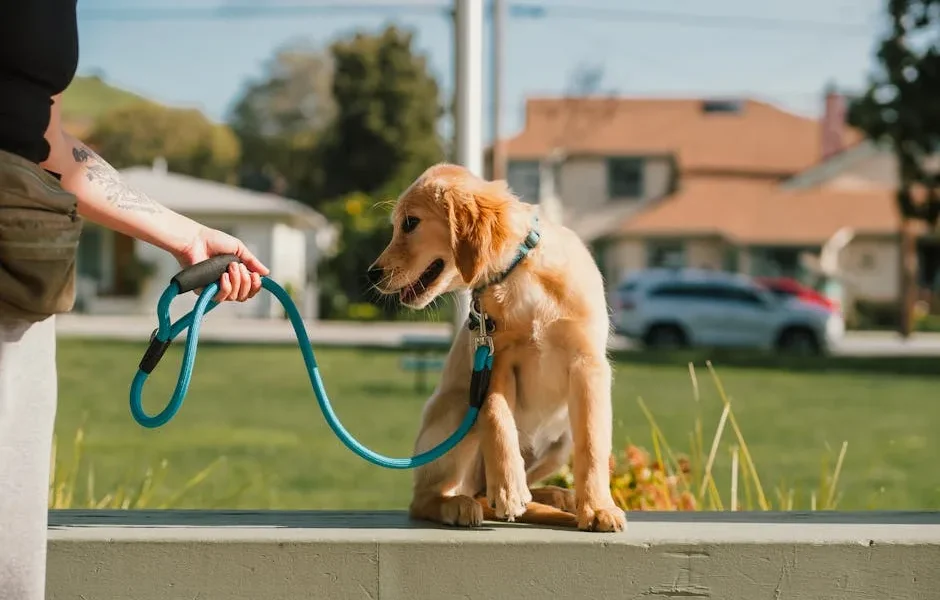
- 80% of dog owners deal with leash pulling. It happens because of natural reflexes, not bad behavior. Learning how to stop your dog from pulling starts with understanding why they do it.
- Front-clip harnesses and reward-based training show 85-90% improvement in 4-6 weeks. They also reduce stress and health problems like throat damage.
- You must be consistent. Dogs need 50-100 rewarded repetitions to learn loose-leash walking. Mixed messages can make training take 200-300% longer.
I’ll never forget the morning Mrs. Patterson walked into our clinic with her Golden Retriever, Max. She was wearing a neck brace. Not Max—her.
Three years of being dragged down the sidewalk had finally hurt her shoulder. Walking her beloved dog had become nearly impossible. She looked defeated.
“I love him,” she said with tears in her eyes. “But I can’t keep doing this. Am I a bad owner?”
That conversation happens more often than you’d think. Here’s what I told her then, and what I’m telling you now: you’re not failing as a dog owner.
Your dog isn’t trying to punish you or dominate you. What’s happening is actually fascinating. And it’s completely fixable.
Why Understanding the Opposition Reflex Changes Everything
Max wasn’t pulling because he was stubborn. He wasn’t poorly trained.
He was responding to something called the opposition reflex. It’s a hardwired brain response that we see in virtually all mammals.
When pressure is applied to a dog’s chest or neck, their instinct is to push back against it. It’s the same reason a toddler pulls away when you grab their hand.
Think about it. Every time Max pulled, the collar tightened around his neck. His brain saw this as pressure to resist. So he pushed forward harder.
Mrs. Patterson pulled back with more force. Max pushed even harder.
A perfect biological standoff that could have continued indefinitely. Except her shoulder gave out first.
This is where veterinary training methods are different from old-school “alpha dog” approaches. We’re not trying to win a strength contest. We’re working with canine brain science, not against it.
The Hidden Health Costs Nobody Talks About
Before we jump into training techniques, you need to understand something important. Chronic leash pulling isn’t just annoying. It’s medically significant.
We’ve documented throat damage, neck strain, and increased eye pressure in dogs who pull constantly. This is especially true in flat-faced breeds like Bulldogs and Pugs.
Front-clip harnesses reduce neck pressure by 50% compared to collars. That’s not a small difference when we’re talking about your dog’s long-term health.
I’ve treated too many dogs with collapsed windpipes that could have been prevented. It’s one of those things that makes me wish I could hand out harnesses like prescription medication.
The Veterinary Training Protocol That Actually Works
Here’s what I demonstrated for Mrs. Patterson in the parking lot that day. It’s the same protocol endorsed by the American Veterinary Society of Animal Behavior and certified veterinary behaviorists.
Step One: Equipment That Works With Biology, Not Against It
We started by switching Max from his flat collar to a front-clip harness.
Studies show these reduce pulling force by 40-60% immediately. That’s before any training even begins.
The mechanics are simple. When a dog pulls forward with a front-clip harness, the pulling motion turns them back toward you. They’re literally redirecting themselves.
Head halters are another option. They work especially well for large, strong dogs.
Some owners worry they look like muzzles. They’re not. But the advantage is undeniable. Where the head goes, the body follows.
Back-clip harnesses? Those actually increase pulling. They give your dog better leverage. They’re designed for sled dogs who are supposed to pull. Not ideal for neighborhood walks.
The Stop-and-Wait Technique: Boring But Brutally Effective
This is the foundation of every successful loose-leash training program I’ve seen in twenty years. It’s unglamorous. It requires patience.
And it works.
The moment the leash becomes tight—stop walking. Don’t yank. Don’t say anything. Just become a tree.
Wait until your dog releases the pressure and looks back at you. Even for a split second.
The instant they do, say “yes!” and move forward again. Forward motion becomes the reward for a loose leash.
Mrs. Patterson’s first attempt took 15 minutes to walk 30 feet. She texted me, frustrated.
I told her that was perfect. She was doing it right.
By day three, they were covering twice the distance. By week two, Max was checking in with her regularly.
The research backs this up beautifully. Positive reinforcement methods show 85-90% improvement rates within 4-6 weeks. Compare that to 60-65% with punishment-based methods.
Plus, dogs trained with rewards show significantly lower stress markers. That matters to us as veterinarians. Chronic stress suppresses immune function and contributes to all sorts of health problems down the line.
The Reward Zone Strategy
Once your dog understands that pulling stops all forward progress, you introduce active rewards.
Define a “reward zone.” That’s the space right next to your leg where you want your dog to walk.
Every few steps that they stay in that zone, give them a small, high-value treat.
High-value is key here. We’re not talking about their regular kibble. Think small pieces of chicken, cheese, or whatever makes your dog lose their mind with excitement.
You’re competing with squirrels and interesting smells. Bring your A-game.
Here’s the veterinary insight most trainers don’t emphasize: dogs require an average of 50-100 repetitions of rewarded loose-leash behavior to establish the habit.
That’s not 50-100 walks. That’s 50-100 moments within walks where they make the right choice and get rewarded for it.
If you’re doing this correctly, you should go through a lot of treats in the first few weeks.
When Pulling Signals Something Deeper
Sometimes leash pulling isn’t about training at all.
It’s about pain, anxiety, or medical issues. These need veterinary attention before behavioral modification can succeed.
I once worked with a Labrador whose sudden aggressive pulling turned out to be early-stage hip dysplasia. He was rushing through walks because walking hurt. He wanted to get home.
Another dog’s pulling was actually leash reactivity. That’s anxiety-driven behavior that required specialized treatment for fear-based behaviors.
Vision problems, cognitive dysfunction in senior dogs, and thyroid issues can all show up as changes in leash behavior.
If your dog suddenly starts pulling after years of walking politely, schedule a veterinary exam before starting a training program. Same thing if the pulling seems panicked rather than enthusiastic.
Red Flags That Mean “Call Your Vet”
Watch for these warning signs that pulling may be medical or require professional behavioral help:
- Sudden onset in a previously well-behaved dog
- Pulling accompanied by whining, panting, or other signs of distress
- Pulling only in certain environments (possible anxiety or reactivity)
- Aggression toward other dogs or people while on leash
- Pulling so intense the dog seems “out of control” or unable to respond to their name
These aren’t training problems. They’re veterinary behavioral cases. They benefit from medications, specialized protocols, or both.
The Mistakes That Make Everything Worse
Let me tell you what doesn’t work. I see these approaches fail every single week.
Retractable leashes teach your dog that pulling gets them more freedom. That’s exactly the opposite of what you want.
They’re also dangerous. I’ve treated cuts, broken fingers, and even a traumatic eye injury from retractable leash accidents.
Pulling back harder just escalates that opposition reflex we talked about. You’re engaging in a strength competition you’ll eventually lose. Especially as your dog gets stronger and you get older.
Punishment-based methods include choke chains, prong collars, and shock collars. They might suppress pulling temporarily. But they don’t teach your dog what you actually want them to do.
Plus, they carry real risks. Throat damage. Increased aggression. Learned helplessness.
The American Veterinary Society of Animal Behavior doesn’t recommend them. Neither do we.
The Consistency Problem
Here’s the mistake that derails more training programs than any other: inconsistency.
If you stop when your dog pulls on Monday but let them drag you to the mailbox on Tuesday because you’re in a hurry, you’ve just taught them that pulling works sometimes.
Dogs don’t understand “sometimes.” They understand patterns.
Inconsistent training extends the training timeline by 200-300%. That’s not my opinion. That’s data from applied animal behavior studies.
Every family member needs to use the same techniques. Every single walk. No exceptions during the learning phase.
Age-Specific Approaches That Respect Development
Puppies trained with loose-leash walking before 16 weeks have a 75% lower likelihood of developing chronic pulling behaviors in adulthood. That’s huge.
If you have a puppy, start now. Keep training sessions short (5-10 minutes). Use lots of rewards. Focus on making walks fun rather than perfectly controlled.
Adolescent dogs (roughly 6-18 months) are going through their rebellious teenager phase. Their impulse control is still developing.
Expect some regression. Stay patient. Remember that their brain is literally under construction.
This is also when many dogs become leash reactive. So socialization matters as much as leash training. Just like you might need to adjust your pet’s nutrition during growth phases—watching for signs their diet supports their development—training approaches should match their developmental stage.
Adult dogs with years of pulling history? Yes, you can retrain them.
Mrs. Patterson proved it with Max, who was five years old when we started. It takes longer—expect 8-12 weeks instead of 4-6. But the success rate is still 80%+ with consistent positive reinforcement.
Older dogs aren’t more stubborn. They just have more practice doing it wrong.
Senior dogs may need modified expectations. If your 12-year-old dog has arthritis, they might pull because certain gaits are less painful than others.
Work with your veterinarian to manage pain. Then adjust your training to accommodate their physical limitations.
When to Bring in the Professionals
Sometimes DIY training hits a wall. And that’s okay.
Veterinary behaviorists are board-certified specialists. They’ve completed years of additional training beyond veterinary school.
They’re particularly valuable for dogs with anxiety-based pulling, reactivity, or aggression on leash.
Many veterinary hospitals now offer Fear Free certified training programs. These use low-stress handling techniques. These programs recognize that learning can’t happen when a dog is terrified or overwhelmed.
If you’ve been consistent for 6-8 weeks and seeing no improvement, get professional help. Same thing if training sessions end with you or your dog stressed and frustrated.
Professional help isn’t a luxury. It’s a smart investment in your dog’s wellbeing and your relationship.
Final Thoughts
Six months after that parking lot training session, Mrs. Patterson sent me a photo. Her and Max on a hiking trail. Both of them relaxed and happy.
The leash formed a gentle “J” shape between them.
She’d done the work. Those boring 15-minute parking lot sessions. The hundreds of treats. The consistency even when it felt ridiculous.
And Max had learned that walking beside her was way more rewarding than pulling her down the street.
That’s what veterinary training methods offer. An approach grounded in how dogs actually learn. Respectful of their biology. Backed by research showing it works.
It’s not about dominance or force. It’s about clear communication and making the right choice the easiest choice.
Start with proper equipment. A front-clip harness is your best friend here.
Practice the stop-and-wait technique on every walk. No exceptions.
Reward heavily when your dog chooses to walk beside you.
Be patient with the repetitions needed to build the habit.
And remember: if you’re struggling, or if your dog’s pulling seems rooted in anxiety or medical issues, we’re here to help.
Your shoulder—and your dog’s throat—will thank you.
Sources & Further Reading
- American Veterinary Society of Animal Behavior — Position statements on humane, effective training methods and the risks of punishment-based techniques
- American College of Veterinary Behaviorists — Resources on when to seek professional behavioral help and finding board-certified specialists
- Fear Free Pets — Veterinary-backed training methodology emphasizing low-stress handling and positive reinforcement
- American Veterinary Medical Association — Evidence-based pet behavior resources and training guidance
- Certification Council for Professional Dog Trainers — Science-based training information and guidance on selecting qualified trainers
