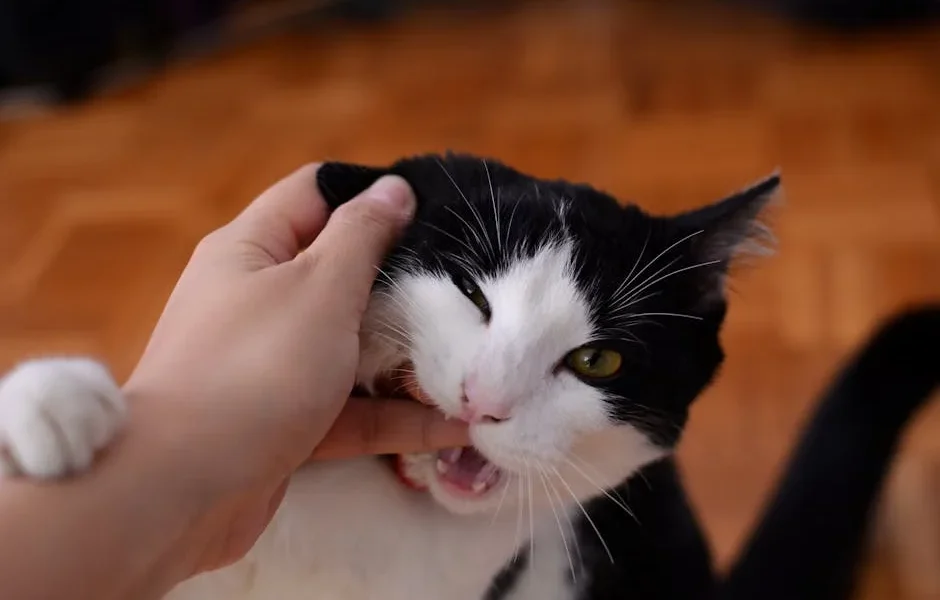
- Petting-induced aggression affects 50-70% of cats. It usually comes from overstimulation. It’s not meanness or aggression.
- Cats show warning signs 85% of the time before biting. Watch for tail twitching, ear rotation, dilated pupils, and skin rippling.
- Most cats have a petting tolerance of 3-5 minutes. Respecting these limits prevents bites. It also strengthens your bond.
- Location matters. Cats tolerate head and chin scratches well. But belly and tail base touches trigger defensive responses in over 70% of cats.
Ever been snuggling with your cat? You’re enjoying what seemed like a peaceful moment. Then suddenly—chomp! Your sweet kitty just bit your hand.
What gives?
Understanding why your cat bites during petting is important. Learning feline body language can help too. These things can transform confusing interactions into pleasant bonding sessions.
I’ve seen this scenario play out countless times at our clinic. And honestly? Your cat isn’t being mean. They’re just speaking a language most of us never learned.
Let’s decode what your cat is really trying to tell you.
Why Does My Cat Seem Happy (Even Purring!) But Then Suddenly Bite Me?
This is probably the most confusing scenario for cat owners.
Your cat’s purring. Eyes half-closed. They seem content. And then bam—teeth on skin.
What you’re witnessing is called petting-induced aggression. It affects somewhere between 50-70% of cats to varying degrees.
Here’s the thing: purring doesn’t always mean pure happiness.
Cats also purr when they’re anxious. They purr when they’re in pain. They purr when trying to self-soothe.
So that purr might’ve been your cat’s way of saying “I’m trying to handle this sensation, but I’m reaching my limit.”
The science behind this involves something called overstimulation.
Cats have incredibly sensitive hair follicle receptors throughout their skin. When you pet them repeatedly, especially in the same spot, it creates a buildup of sensory input.
It’s kind of like when someone tickles you. It goes from pleasant to unbearable.
Some researchers even suggest static electricity buildup plays a role.
Most cats have a petting tolerance threshold of about 3-5 minutes. After that, their nervous system says “enough.”
Your cat wasn’t lying about enjoying those first few minutes. They just hit their limit. The bite is their way of saying “I need a break now, please.”
The Overstimulation Timeline
Think of it like a battery draining.
Your cat starts at 100% tolerance. Each stroke draws down that reserve.
Some cats have huge batteries. They’ll cuddle for hours.
Others have smaller ones and tap out quickly.
Neither is wrong. They’re just wired differently. This is based on genetics, early socialization, and individual temperament.
How Can I Tell When My Cat Is About to Bite?
Good news: cats telegraph their intentions about 85% of the time.
The bad news? We humans often miss the signals. We miss them until we’ve learned what to look for.
Watch for these warning signs. They typically appear 10-30 seconds before a bite:
- Tail twitching or thrashing—this is your biggest red flag. A gently swaying tail is fine. But rapid flicking or thumping means “stop now.”
- Ears rotating backward or flattening—even slightly. Forward, relaxed ears mean contentment. Anything else signals discomfort.
- Dilated pupils—suddenly enlarged eyes indicate arousal or stress. This happens even if the rest of the body looks relaxed.
- Skin rippling along the back—that wave-like movement shows sensory overload.
- Body stiffening—cats go from loose and floppy to tense and rigid.
- Whiskers pulled back against the face rather than relaxed and forward.
- Sudden stillness—if your cat was moving around and suddenly freezes, that’s not meditation. That’s discomfort.
A 2024 study from UK and Portuguese universities identified specific “frustration grimace” expressions. These involve subtle whisker positions and ear angles that precede petting aggression.
Cats are constantly communicating. We just need to pay attention.
If you notice any of these signs, stop petting immediately.
Give your cat space. Don’t take it personally.
You just successfully read their body language. You prevented an uncomfortable situation for both of you.
What’s the Difference Between a “Love Bite” and an Aggressive Bite?
Not all bites are created equal. This distinction matters.
A love bite (or affection bite) is typically gentle. It doesn’t break skin. It comes without other stress signals.
Your cat’s ears are forward. Pupils normal. Tail relaxed.
They might grab your hand softly with their teeth while bunting (head-rubbing) or kneading. This is often affectionate overexcitement.
It’s kind of like how some people squeeze things when they’re overwhelmed with cuteness.
An aggressive or overstimulation bite involves more pressure. It often does break skin. It’s preceded by those warning signals we discussed.
The cat’s body language clearly says “stressed” or “overwhelmed.”
This bite is communication, not affection. They’re setting a boundary.
The pressure and context tell the story. Love bites feel like gentle pressure. Overstimulation bites hurt.
If you’re bleeding or seeing teeth marks, that wasn’t a love bite. Your cat was genuinely done with being touched.
Similar to understanding behavioral signals in dogs, learning to read these feline cues can also alert you to potential health issues.
A cat who suddenly becomes bite-y during petting might be experiencing pain.
Are There Certain Spots I Should Avoid When Petting My Cat?
Absolutely.
Cats have very clear preferences about where they want to be touched. Ignoring these preferences is a fast track to getting bitten.
Research shows cats typically tolerate 3-4 specific locations well:
- Head and forehead—most cats love this.
- Cheeks and chin—where their scent glands are located.
- Base of ears—gentle scratches here are usually welcome.
- Upper neck and shoulders—generally safe territory.
Now for the danger zones. These areas trigger defensive responses in over 70% of cats:
- Belly—this is the big one. Yes, your cat might roll over and expose their belly. But that’s usually a sign of trust, not an invitation to pet. The belly is vulnerable. Touching it activates defensive instincts in most cats.
- Tail base and tail—this area can be overstimulating quickly.
- Paws and legs—most cats are sensitive about their feet.
- Lower back near hips—some cats like this. But many find it too stimulating.
Think of it as a “petting map.”
Stick to the green zones (head, cheeks, chin) and you’ll have much better success.
The red zones? Only if your individual cat has specifically shown they enjoy it. And even then, proceed with caution.
Can I Train My Cat to Tolerate Longer Petting Sessions?
Sort of, but with important caveats.
You can work on extending your cat’s tolerance. You can use positive reinforcement and counterconditioning.
But you’ll never turn a 2-minute cat into a 30-minute lap warmer if that’s not who they are neurologically.
Here’s what actually works:
Use consent-based petting. Let your cat initiate interaction.
When they approach you, pet them briefly (like 30 seconds). Then stop.
If they lean in, rub against you, or stay close, you can continue. If they walk away, respect that.
This teaches them that petting sessions end before they become uncomfortable. Ironically, this often leads to cats seeking out MORE interaction. They trust you to respect their boundaries.
Keep sessions short and positive. Always stop before you see warning signs.
If your cat tolerates 2 minutes, stop at 1.5 minutes. End on a good note, every time.
Over weeks, you might be able to very gradually extend this. But some cats will plateau. And that’s okay.
Pair petting with high-value treats. For cats who are touch-sensitive, you can sometimes improve their tolerance.
Offer a favorite treat during brief, gentle petting sessions in preferred areas. This creates positive associations.
But this works best for mildly sensitive cats. Not those who are truly touch-averse.
Address early socialization gaps. Cats under-socialized before 7-9 weeks of age show three times higher rates of petting aggression.
If you have a kitten, extensive gentle handling during that critical period helps.
For adult cats who missed this window, you’re managing their preferences more than changing them.
The honest answer? Accept your cat’s limits.
A cat who wants 3 minutes of petting isn’t defective. They’re just themselves.
Working within their comfort zone actually strengthens your bond more than forcing them to endure interactions they dislike.
Could My Cat’s Biting Be a Sign of a Health Problem?
Sometimes, yes.
If your previously tolerant cat suddenly starts biting during petting, pain is a real possibility.
Cats are masters at hiding discomfort. But petting-induced aggression can be one of the few visible signs.
Consider these scenarios:
- Arthritis—especially in senior cats. Petting along the spine or hips might hurt.
- Dental disease—if head or cheek petting suddenly triggers biting, check for tooth pain.
- Skin conditions—allergies, infections, or parasites make touch uncomfortable.
- Neurological issues—conditions affecting nerve sensitivity.
- Hyperthyroidism—can cause irritability and lower tolerance thresholds in older cats.
When should you worry?
If the behavior represents a significant change from your cat’s baseline, schedule a veterinary exam.
At Animal Hospital Clinic, we regularly see cases where “sudden aggression” was actually pain communication.
Similar to how behavioral changes can indicate health issues in dogs, cats use behavior to tell us when something’s wrong.
A complete physical exam can help. You might need diagnostic testing like blood work or X-rays.
This can rule out medical causes.
Don’t assume it’s just “behavior” until you’ve eliminated pain or illness as factors.
Why Does My Cat Bite Me But Not Other Family Members?
Cats absolutely play favorites. They have different relationships with different household members.
This isn’t personal. Well, actually, it is personal. But not in a mean way.
Several factors influence this:
Petting technique. You might be petting harder, faster, or in areas your cat dislikes.
Watch how the “preferred” person interacts. They might be doing something differently that you’re missing.
Body language reading. Some people are naturally better at noticing and responding to cat warning signs.
If you consistently miss the “please stop” signals, your cat learns you’re not trustworthy in that context. They escalate to biting sooner.
Energy levels. Cats often gravitate toward calmer, quieter people.
If you’re more animated or move more quickly, your cat might be slightly more on edge around you.
Association patterns. If you’re the one who gives medications, trims nails, or does other unpleasant tasks, your cat might be more defensive with you generally.
Individual history. If your cat had negative experiences with someone who resembles you (similar voice, gender, or mannerisms), they might be more reactive.
The solution? Observe what the “favorite” person does and mimic it.
Let your cat come to you. Keep sessions short. Stop before any warning signs appear.
Over time, you can rebuild trust and change the dynamic.
Just like finding the right veterinarian requires building trust, so does building a better relationship with a cautious cat.
Final Thoughts
Understanding why your cat bites during petting isn’t about fixing a “problem cat.”
It’s about learning to speak their language.
Those bites are communication, not character flaws. Your cat is telling you, clearly and consistently, when they’ve reached their limit.
The question is whether you’re listening.
Start paying attention to those early warning signs. Tail flicks. Ear rotations. Pupil dilation. Skin rippling.
Stop petting before these escalate.
Stick to cat-approved zones like the head and cheeks. Let your cat control interaction length by walking away when they’re done.
These simple shifts can transform your relationship.
And if the biting represents a sudden change? Schedule a veterinary exam to rule out pain or illness.
We’re here to help you understand not just what your cat is doing, but why. And how to build a relationship based on respect and trust rather than confusion and frustration.
Sources & Further Reading
- Cornell Feline Health Center — Comprehensive resources on petting-induced aggression and feline behavior patterns
- American Association of Feline Practitioners — Evidence-based guides on reading feline body language and warning signals
- UC Davis School of Veterinary Medicine — Research on cat behavior and petting tolerance thresholds
- International Cat Care — Evidence-based information on overstimulation and sensory processing in cats
- Applied Animal Behaviour Science — Peer-reviewed research on feline sensory sensitivity and petting-induced aggression
