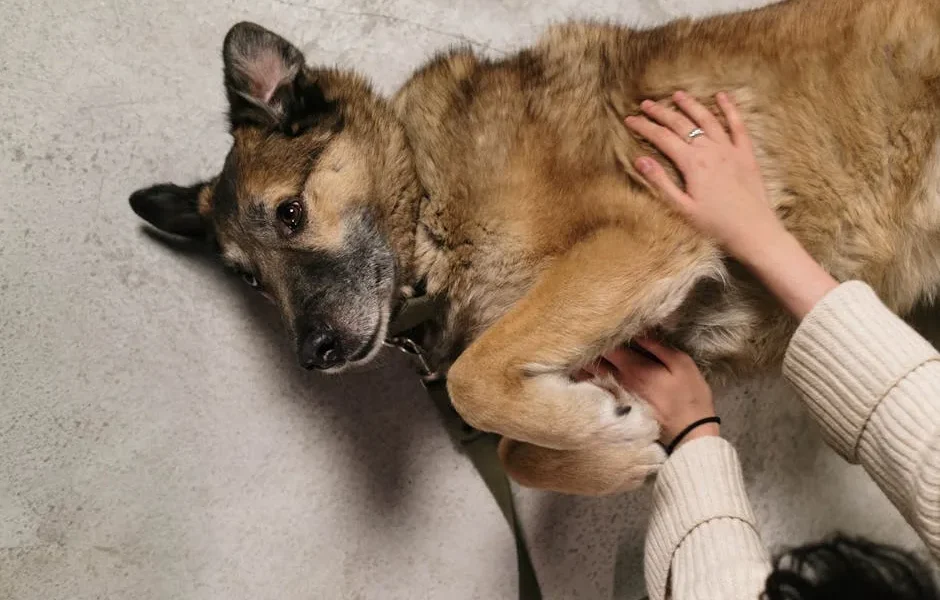
- Pet Bloat (GDV) Emergency: Recognize Life-Threatening Stomach Torsion & Act Fast 2025 — GDV has a mortality rate of 10-30% even with immediate treatment. Dogs can die within 1-2 hours without emergency surgery.
- Classic warning signs include a distended abdomen, unproductive retching, excessive drooling, and restlessness. If you see these symptoms together, get to an emergency vet immediately.
- Large, deep-chested breeds like Great Danes have up to a 42% lifetime risk. Preventive gastropexy surgery reduces recurrence from 80% to under 5%.
I’ll never forget the call I got at 2 a.m. It was from a Great Dane owner. She’d been watching her dog pace for “just 20 minutes.” Then she decided something was really wrong.
By the time they arrived, we had maybe a 45-minute window to save him. That’s GDV — gastric dilatation-volvulus, or bloat with stomach torsion. It’s one of the few true veterinary emergencies where every minute literally counts.
After 15 years in emergency medicine, I’ve seen too many cases. Owners didn’t know what they were looking at until it was almost too late.
Here’s what keeps me up at night: Only about 30% of pet owners can identify early GDV symptoms. The average delay to veterinary care is 3-4 hours. That delay is often the difference between life and death.
So let’s fix that gap right now.
Why GDV Is Different From Regular Stomach Upset
Your dog’s had an upset stomach before, right? Maybe ate something questionable. Vomited a couple times. Seemed uncomfortable. That’s not this.
In GDV, the stomach fills with gas. Then it rotates on itself. Imagine twisting a balloon until both ends are sealed shut. Nothing can get in or out.
The stomach continues to expand like a balloon. It cuts off blood supply to vital organs. It compresses major blood vessels. It triggers a cascade of shock.
Without surgical intervention, dogs typically die within hours. The mortality rate sits between 10-30% even with aggressive treatment. Without surgery, it approaches 100%.
The torsion is the killer. Simple bloating (dilatation without torsion) is serious but usually manageable. Once that stomach flips, you’re in a race against systemic shock and organ failure.
Step 1: Know If Your Dog Is High-Risk
Some dogs are just built differently. And that anatomy matters here.
Large, deep-chested breeds have 5-8 times higher risk than other dogs.
The highest-risk breeds include:
- Great Danes (42% lifetime risk — nearly half will experience GDV)
- German Shepherds
- Standard Poodles
- Weimaraners
- Doberman Pinschers
- Saint Bernards
- Irish Setters
- Bloodhounds
But here’s the thing: I’ve treated GDV in Basset Hounds. I’ve treated mixed breeds. Even one memorable Cocker Spaniel.
It’s not exclusive to giant breeds. Just vastly more common.
Age matters too. Most cases occur in dogs between 7-10 years old. Males are twice as likely as females to develop it.
If you own a high-risk breed, you need to have this conversation with your vet. Talk about preventive surgery. I mean it. We’ll get to that later.
Step 2: Recognize the Warning Signs Immediately
This is the section you need to memorize. Print it out and stick it on your fridge if your dog is high-risk.
The Classic GDV Presentation
Watch for these symptoms appearing together. They usually show up within 1-2 hours after eating:
- Distended, hard abdomen: The belly becomes visibly swollen and tight like a drum. You can sometimes see the distension from across the room.
- Unproductive retching: They try to vomit but nothing comes up. This is the hallmark sign. Repeated attempts with maybe just foam or saliva.
- Excessive drooling: We’re talking strings of saliva, not just a wet mouth.
- Restlessness and pacing: They can’t get comfortable. They keep changing positions. They seem anxious or distressed.
- Rapid, shallow breathing: The distended stomach compresses the diaphragm.
- Weak pulse or collapse: This means shock is setting in. You’re running out of time.
The 15-Minute Home Assessment
If you suspect GDV, do this quick check. Have someone else call the emergency vet while you check:
Check their gums. Press your finger against the gum above a tooth. Normal is pink. It should return to pink within 2 seconds after you release. Pale, white, or brick-red gums with slow refill time? Bad sign.
Tap the abdomen gently. Does it sound hollow, like tapping a watermelon? That’s gas accumulation.
Try to assess their pain level. Most GDV dogs resist touching their abdomen. They may turn to look at their belly repeatedly.
Look at their posture. Many dogs adopt a “praying” position. Front legs down and rear end up. They’re trying to relieve abdominal pressure.
Step 3: Get to Emergency Care NOW (Not in an Hour)
Here’s where people make the fatal mistake: waiting to see if it gets better.
It won’t.
If you see multiple symptoms from that list above, you need to act now. Especially the distended abdomen plus unproductive retching combo. You need to be driving to the emergency vet right now.
Don’t wait until morning. Don’t call your regular vet’s office and leave a message. Don’t post on Facebook asking if you should be worried.
Time benchmarks that matter: Survival rates drop significantly after 6 hours from onset. Dogs can go into irreversible shock within 1-2 hours. The tissue damage to the stomach starts immediately once blood supply is cut off.
What to Tell the Emergency Hospital
Call ahead while driving if possible. Have a passenger call safely.
Tell them: “I’m coming in with suspected GDV. Large breed dog, distended abdomen, unproductive retching, arrived X minutes ago. We’re 15 minutes away.”
This lets them prep the surgery suite and assemble the team.
In my emergency department, a GDV call triggers a specific protocol. We get IV catheters ready. We pull up anesthetic drugs. We have the surgeon scrubbed before you walk through the door.
You can read more about what to expect in our emergency vet costs guide so you’re prepared.
Step 4: Understand What Happens at the Emergency Vet
I want you to know what we’re doing. So the chaos makes sense when you’re there.
First, we stabilize. Large-bore IV catheters go in immediately. This is for aggressive fluid therapy to combat shock.
We’ll take radiographs. Usually one right-lateral X-ray is enough to diagnose GDV. The stomach will show a characteristic “double bubble” or “Popeye arm” appearance when twisted.
If it’s just dilatation without torsion, we might try stomach decompression with a tube first. But if it’s true volvulus (torsion), your dog needs surgery. Period. There’s no medical management option that works.
The surgery involves three steps:
First, decompressing the stomach. Second, untwisting it. Third, assessing tissue viability (removing any dead tissue). Fourth, performing a gastropexy — permanently tacking the stomach to the body wall so it can’t twist again.
Cost reality check: GDV surgery typically runs $2,000-$8,000. This depends on your location. It also depends on whether there are complications like removing part of the stomach or spleen.
It’s expensive because it’s major abdominal surgery. It requires specialized skills and intensive monitoring.
Most emergency hospitals will discuss payment options before proceeding. This includes CareCredit.
Step 5: Consider Preventive Gastropexy for High-Risk Dogs
This is the conversation I wish more owners had with their vets before a crisis.
Preventive gastropexy is a surgical procedure. We permanently attach the stomach to the body wall. It doesn’t prevent the stomach from dilating with gas. But it absolutely prevents torsion.
And torsion is what kills dogs.
The stats are compelling: Without gastropexy, 80% of dogs who survive one GDV episode will have it happen again. With gastropexy, recurrence drops below 5%.
When and How to Do It
The ideal time is during a planned procedure your dog is already having. Most commonly during spay or neuter surgery in young adults.
The cost is typically $400-$600 when done at the same time as another surgery. It’s $1,500-$2,500 as a standalone procedure.
Laparoscopic gastropexy has become increasingly popular in 2024-2025. It’s minimally invasive. Recovery times are 50% faster compared to traditional open surgery. Most dogs go home the same day or next morning.
If you own a Great Dane, German Shepherd, Standard Poodle, or other high-risk breed, I strongly recommend discussing this with your vet.
The math is simple: Preventive surgery costs less than emergency surgery. It has virtually no mortality risk compared to 10-30% with emergency GDV. Your dog recovers in days instead of weeks.
Common Mistakes That Cost Time (and Lives)
Let me tell you what I see owners do wrong. So you don’t make the same mistakes:
Waiting to see if symptoms improve. They never do. GDV is progressive and rapid. That 30-minute delay while you “monitor the situation” might be the difference.
Confusing GDV with regular vomiting or upset stomach. If your dog is trying to vomit but nothing’s coming up, that’s not regular vomiting. The unproductive retching is the tell.
Going to a general practice vet instead of emergency. Your regular vet probably can’t do emergency GDV surgery. Especially after hours. You need a hospital with 24-hour surgical capabilities. It’s worth knowing ahead of time which facilities near you can handle this. Check out our guide on when to choose specialists or emergency care.
Trying home remedies. I’ve had owners show up after trying to give Gas-X. Or induce vomiting. Or “walk it off.” Please don’t. You’re burning time you don’t have.
Not calling ahead to the emergency hospital. Those few minutes of warning let us prepare. They can shave 15-20 minutes off door-to-surgery time.
Prevention Strategies That Actually Work
Besides preventive gastropexy, certain management practices can reduce risk:
Feed smaller, multiple meals. Dogs fed once daily have twice the risk. This compares to those fed 2-3 times per day. Split that food up.
Slow down fast eaters. Rapid eating increases risk by about 150%. Use slow-feeder bowls or puzzle feeders for dogs who inhale their food.
Limit water immediately after meals. Let them drink. But don’t let them gulp down huge amounts right after eating.
Restrict exercise around mealtimes. Wait at least an hour after eating before vigorous activity. This includes playing, running, and rough-housing.
Manage stress and anxiety. Anxious, nervous dogs appear to have higher risk. Work on stress reduction if your dog is chronically anxious.
One myth I need to bust: elevated food bowls. Recent studies actually show either no benefit or potentially increased risk with elevated feeders in large breed dogs. Feed at ground level unless your vet specifically recommends otherwise for orthopedic reasons.
What Happens After GDV Surgery
If your dog makes it through surgery, you’re not out of the woods yet. But the odds improve dramatically.
The first 48 hours are critical. We monitor for cardiac arrhythmias (irregular heartbeats). These develop in up to 40% of post-GDV dogs. We watch for sepsis, surgical complications, and continued shock.
Most dogs stay hospitalized 2-4 days.
At home, expect restricted activity for 2-3 weeks. Small, frequent meals of bland diet initially. The gastropexy site needs time to heal and form permanent adhesions.
Most dogs return to completely normal activity within 4-6 weeks.
Long-term prognosis is generally excellent for dogs who survive the initial surgery without major complications. The gastropexy is permanent. So they’re protected from future torsion.
When It Might Not Be GDV (But Still Needs Attention)
Sometimes dogs present with similar symptoms that turn out to be something else:
Simple gastric dilatation (bloat without torsion) causes a distended stomach but no twist. It’s still serious and needs decompression. But survival rates are much higher.
Gastritis or gastroenteritis can cause vomiting and abdominal discomfort. But the abdomen usually isn’t that dramatically distended and hard.
Splenic torsion is rarer but can present similarly in large breeds.
Foreign body obstruction causes vomiting but usually not the tympanic (drum-like) abdomen.
Here’s my rule: if you’re not sure, treat it like GDV and go to the ER. Better to have a false alarm than wait and lose your dog.
In 15 years, I’ve never been angry at an owner who brought their dog in for suspected GDV that turned out to be something less serious. I have been heartbroken by the ones who waited too long.
Recent Advances in GDV Diagnosis and Treatment
Things are improving in 2025. Several developments are making a difference:
AI-assisted radiograph interpretation is being piloted at major veterinary hospitals. This reduces diagnosis time by about 40%. Faster diagnosis means faster surgery.
Telemedicine triage protocols are now available through major emergency networks. You can do a video assessment. This helps determine if what you’re seeing is true emergency GDV versus something that can wait until morning. This helps with those gray-area cases where you’re really not sure.
Genetic marker research identified specific genes in Great Danes and Standard Poodles associated with GDV risk in 2024. Eventually, we might be able to screen puppies. We could identify the highest-risk individuals for preventive intervention.
Laparoscopic techniques for gastropexy have become standard of care at many specialty centers. This makes preventive surgery more accessible and less invasive than ever before.
Final Thoughts
GDV is absolutely terrifying. And I won’t sugarcoat that.
But it’s also one of the emergencies where your quick recognition and action make all the difference.
I’ve seen dogs walk out of my hospital after GDV surgery. They live completely normal lives for years afterward. This happens because their owners knew what to look for. They didn’t waste time second-guessing themselves.
If you have a high-risk breed, take action now. Before you’re in a crisis.
Have the gastropexy conversation with your vet. Program your nearest 24-hour emergency hospital into your phone. Make sure everyone in your household knows the warning signs.
And if you ever see that combination of distended abdomen and unproductive retching, drop everything and go.
Don’t wait. Don’t wonder. Don’t Google for another hour. Just go.
Your dog’s life might literally depend on that decision. Fifteen years into this career, I can promise you that the owners who acted immediately never regret it. But the ones who waited almost always do.
Sources & Further Reading
- American College of Veterinary Surgeons — Comprehensive GDV resource covering diagnosis, treatment, and surgical techniques
- Veterinary Emergency & Critical Care Society — Evidence-based GDV emergency protocols and owner resources
- Tufts Cummings School of Veterinary Medicine — Research on GDV risk factors and prevention strategies
- Purdue University Veterinary Studies — Landmark research on breed predisposition and dietary risk factors for GDV
- American Veterinary Medical Association — Pet owner guide to recognizing and responding to bloat emergencies