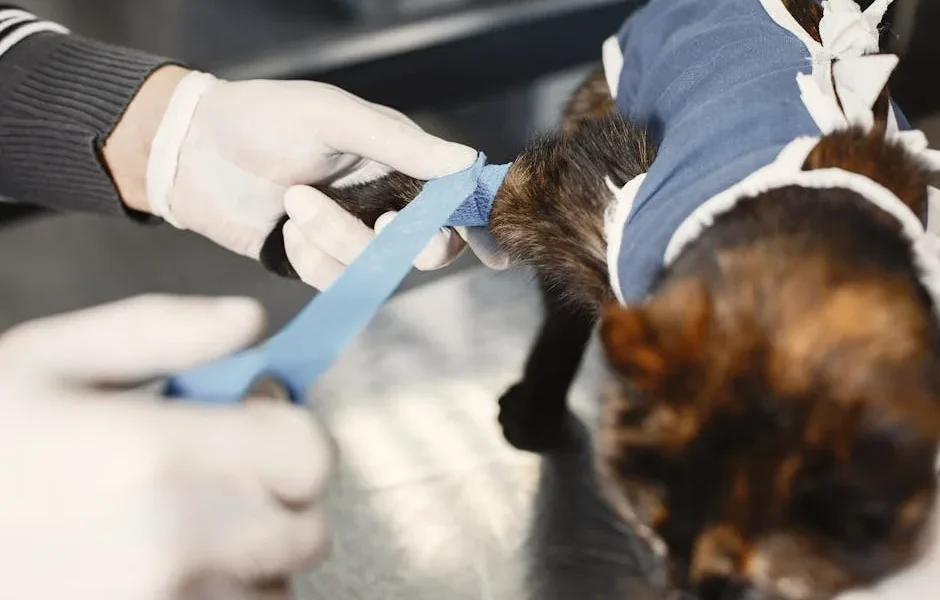
Broken Bones in Pets: How to Stabilize & Prevent Further Injury Before the Vet
I’ll never forget the sound of Luna’s yelp when she jumped off my couch. That wasn’t her usual “ouch” sound. This was different. Sharper. My twelve-pound terrier mix landed funny, and suddenly she was holding her front left leg up like it didn’t belong to her anymore. The leg dangled at an angle that made my stomach drop.
That’s when I realized something terrifying: I had no idea what to do next.
Should I touch it? Wrap it? Pick her up? The fifteen minutes between discovering Luna’s injury and getting her into the car felt like hours, and I made at least three mistakes that could’ve made things worse. Luckily, we got to the emergency vet before any permanent damage occurred, but that experience taught me something crucial that every pet owner needs to know.
What you do in those first critical moments after your pet breaks a bone can mean the difference between a straightforward recovery and permanent complications.
The Truth About Pet Fractures Nobody Tells You
Here’s something that surprised me: broken bones account for roughly 20-25% of all orthopedic cases in veterinary emergency clinics. It’s not rare. It’s not a freak accident. It happens to responsible pet parents every single day.
And small dogs like Luna? We’re at even higher risk. Dogs under 20 pounds have fracture rates three to four times higher than their larger cousins, mostly because their bones are more delicate. Those adorable toy breeds jumping off furniture they think they can totally handle? That’s actually one of the leading causes of radius and ulna fractures.
The femur, tibia, and radius are the usual suspects when it comes to broken bones in pets. But here’s what really matters: approximately 60% of pet owners accidentally make fractures worse by moving their pets incorrectly or trying to stabilize the injury with inappropriate materials.
That’s the stat that haunts me.
How Do You Even Know It’s Broken?
Let’s be real. Not every limp is a fracture. Sometimes it’s a sprain. Sometimes your dog just stepped on something weird. But there are signs that scream “this is serious.”
Luna wasn’t putting any weight on her leg. Not even trying. That’s sign number one. When a pet absolutely refuses to bear weight on a limb, you’re probably dealing with something more than a bruise.
Other red flags include:
- Visible deformity or an angle where there shouldn’t be one
- Swelling that appears within minutes
- Crepitus (that horrible grinding or crunching sensation if you gently touch near the injury)
- The limb hanging loosely or moving in ways that make you feel queasy
- Open wounds with bone visible (this is an emergency-within-an-emergency)
- Your normally gentle pet trying to bite when you approach the injury
That last one deserves emphasis. Even the sweetest pet may bite when they’re in severe pain. Before you do anything else, you need to protect yourself and your pet with proper restraint. Sometimes a soft muzzle is necessary, though if you’ve never done this before and your pet is panicking, you might need a second person to help. Just remember: a towel gently draped over their head can sometimes calm them enough to allow handling.
The Golden Rule: Stabilize, Don’t Fix
This is where I almost screwed up with Luna. I started looking around my house thinking I needed to create some elaborate splint contraption. Wrong approach entirely.
Your job isn’t to fix the fracture. Your job is to prevent it from getting worse before you can get to someone who can actually fix it.
Here’s what proper stabilization actually means: supporting the injured limb in whatever position your pet is naturally holding it, restricting movement, and getting to the vet as quickly and safely as possible. That’s it. You’re not setting bones. You’re not realigning anything. You’re keeping things from moving around and causing more damage.
For most fractures, the best stabilization is simply restricting your pet’s movement. Put small pets in a carrier. Keep larger dogs confined to as small a space as possible during transport. If you absolutely must stabilize a limb before moving them, think soft support, not rigid constraint.
What You Can Actually Use (And What You Absolutely Cannot)
Rolled magazines or newspapers can work as makeshift supports for lower leg fractures if you pad them with towels. The key word is “pad.” Never put rigid material directly against your pet’s skin. You could cause pressure sores or something called compartment syndrome in as little as two to four hours.
Soft towels or blankets work beautifully for support. You can roll them around a limb to provide gentle stability without restricting blood flow. Secure everything with gauze or soft strips of fabric, not tape directly on fur.
What doesn’t work? Duct tape. Seriously, I’ve seen this recommended online and it’s dangerous. Also avoid popsicle sticks, rulers, or anything rigid without significant padding. And please, don’t try to pull or straighten the limb. You could turn a simple fracture into a compound fracture where bone punctures through skin.
Speaking of compound fractures—if you can see bone, if there’s an open wound, this is one of those life-threatening emergencies where time really matters. Cover the wound with a clean, moist cloth and get moving immediately. Open fractures have infection rates five to eight times higher than closed fractures, and they need veterinary attention within six hours for the best outcomes.
The Transport Challenge
Getting Luna into the car without jostling her injured leg was harder than I expected. She wasn’t a cooperative patient, and I was terrified of making things worse.
For small pets, a carrier is your best friend. Line it with soft bedding and place your pet inside as gently as possible. If they’re holding a limb up, don’t try to force it down. Let them position themselves however feels most comfortable.
Larger dogs present a bigger challenge. If you suspect a leg fracture and your dog can’t walk, you need a stretcher. A sturdy board, a large towel held taut by two people, or even a rigid piece of cardboard can work. Slide it under your dog, lift carefully, and keep everything as level as possible. Safe transport of an injured pet is a skill worth learning before you need it.
Drive carefully. I know that sounds obvious, but when you’re panicking, it’s easy to take corners too fast or brake too hard. Every jostle causes pain and could potentially worsen the fracture.
The Pain Medication Question
This is where you need to fight every instinct to grab something from your medicine cabinet.
Do not give your pet ibuprofen. Do not give them aspirin without veterinary guidance. Do not assume that what works for humans is safe for pets. Ibuprofen can cause kidney failure in dogs. Acetaminophen is toxic to cats. Even aspirin, while sometimes used in veterinary medicine, can be dangerous in the wrong dose or situation.
I know it’s awful watching your pet in pain. But the drive to the emergency vet is not the time to experiment with pain medication. The vet needs to assess your pet’s condition without interference from medications that might mask symptoms or interact with what they need to administer.
Your job during transport is comfort and stabilization, not pain management. Talk to your pet in a calm voice. Keep them warm. Drive as smoothly as possible. That’s the best you can do in those critical minutes.
The Timeline That Matters
Fractures should ideally be stabilized by a veterinarian within 24 to 48 hours. Not next week when your regular vet has an opening. Not when you’ve saved enough money. Within two days.
Why? Because delays beyond 72 hours significantly increase surgical complexity and recovery time. Bones start healing on their own, even if they’re misaligned. Soft tissue swelling increases. The risk of infection goes up. What could’ve been a relatively straightforward procedure becomes complicated.
I’ve talked to pet owners who waited because they weren’t sure it was “that bad” or because they were worried about the cost. I get it. Emergency fracture treatment can run anywhere from $1,500 to over $5,000 depending on the severity and location. But here’s the thing: delayed treatment can increase those costs by 40-60% because complications require more extensive surgery.
Plus, some fractures carry unique risks based on timing. Puppies and kittens under six months old can suffer growth plate fractures, which make up about 30-35% of pediatric cases. These require different surgical approaches, and improper healing can cause permanent limb deformities or legs that grow to different lengths.
What Absolutely Requires Immediate Emergency Care
Not all fractures are created equal. Some situations mean you need to get moving right now, as in within the first critical minutes:
- Open fractures with visible bone
- Signs of shock (pale gums, rapid breathing, weak pulse, collapse)
- Suspected spinal involvement (inability to move back legs, loss of bladder control)
- Multiple fractures from trauma like a car accident
- Fractures accompanied by seizure activity
- Difficulty breathing (could indicate rib fractures or internal injuries)
These scenarios go beyond a single broken leg. They indicate systemic trauma that could be life-threatening.
The Prevention Talk We Need to Have
After Luna’s fracture healed—thankfully, she made a complete recovery—I looked at my house with completely different eyes.
That couch she loved jumping off? I built her a little ramp. Took me one afternoon and maybe forty bucks in materials. She thought I was being ridiculous at first, but she uses it now.
For high-risk breeds, especially toy breeds, environmental modifications matter. Ramps or pet stairs for furniture. No unsupervised access to high surfaces. Baby gates to prevent falls down stairs. These aren’t overprotective measures. They’re practical prevention for dogs whose bones are genuinely more fragile.
If you have cats, secure those window screens. High-rise syndrome is a real thing, and it peaks during warmer months when windows stay open. Cats think they have better balance than they do. They don’t always land on their feet, and when they fall from height, fractures are often the least of the injuries.
Falls account for about 40% of pet fractures, vehicle accidents for another 30%, and rough play or dog fights for around 15%. A lot of these are preventable with basic awareness.
Some people swear by bone health supplements, especially for senior pets or breeds prone to fractures. Glucosamine, omega-3 fatty acids, and calcium supplements come up a lot in these discussions. I’m not a vet, so I can’t tell you whether they work, but I can tell you it’s worth discussing with yours during regular checkups.
One prevention tip that surprised me: the harness versus collar debate actually extends to fracture risk. Dogs who pull hard on leashes can sustain leg fractures during sudden stops or leash accidents. A properly fitted harness distributes force across the chest instead of the neck, which can reduce injury risk during those unexpected lunges at squirrels.
What I Wish I’d Known Before Luna Got Hurt
The biggest lesson from that scary afternoon wasn’t about splinting techniques or transport methods. It was about preparation.
I wish I’d known where my nearest 24-hour emergency vet was located. I wish I’d had their number programmed in my phone. I wish I’d thought through “what would I do if…” scenarios before facing one.
Now I keep a pet first aid kit in my car. Not because I think I’m going to perform emergency surgery, but because having basic supplies—gauze, towels, a muzzle, the vet’s number, a blanket—means I’m not scrambling around in a panic when seconds count.
I also wish I’d understood that doing nothing is sometimes better than doing something wrong. My instinct to fix, to splint, to make it better could’ve made things worse if I’d acted on it impulsively. Sometimes the most important first aid skill is knowing when to simply provide comfort and get professional help quickly.
Luna’s fine now. She still loves that couch, though she takes the ramp these days. And honestly? Every time I see her trotting around on all four legs, pain-free and happy, I’m grateful we got lucky. That her fracture wasn’t worse. That I didn’t make critical mistakes in those first frightening minutes.
But I also know how easily it could’ve gone differently. How many pet owners face this same emergency and don’t know where to start. If you’re reading this before you need it—good. Take a few minutes to find your nearest emergency vet. Think about how you’d safely transport your pet. Identify potential fracture risks in your home and fix them.
And if you’re reading this because your pet just got hurt, take a breath. You can do this. Support the injured area gently, restrict movement, and get to that vet as quickly and safely as possible. You don’t need to be perfect. You just need to prevent further injury until the professionals can take over.
That’s something you’re absolutely capable of doing.

Medically reviewed by: Dr. Sarah Chen, DVM, DACVIM